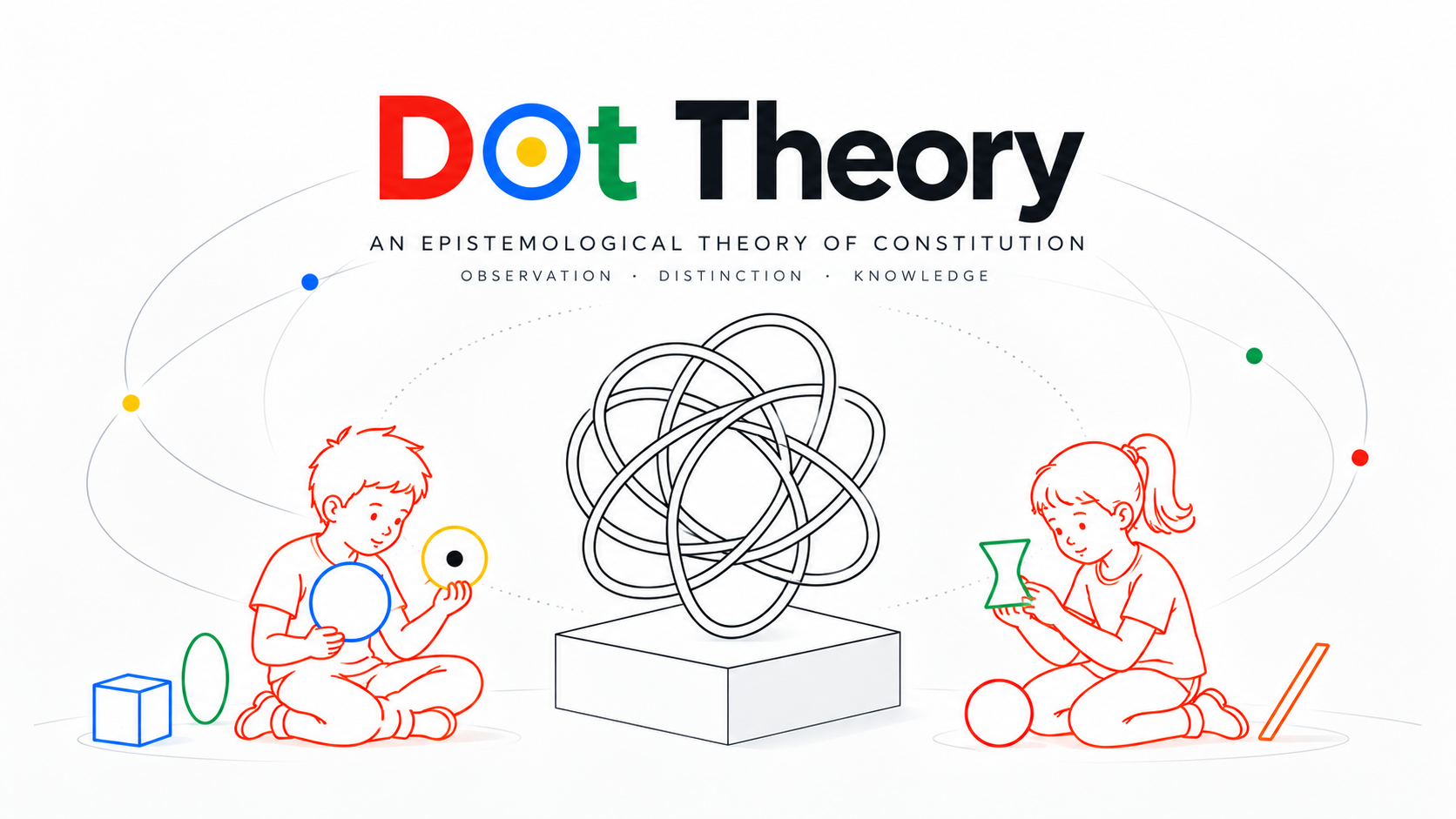
Dot Theory
An epistemological theory of constitution
A governance architecture for communicable scientific reality
Programme Architecture, Jurisdiction & Local Implementation
DOI: 10.5281/zenodo.23063830
Canonical Constitutional Record — CCR
DOI: 10.5281/zenodo.21535574
Scholarly Positioning & Comparative Literature Review — CP-SPLR-001
DOI: 10.5281/zenodo.21534139
F O R M — Constitutional Verification Protocol
DOI: 10.5281/zenodo.22875795
Scientific Epistemic Metrology — SEM
DOI: 10.5281/zenodo.23041075
DOT THEORY ASKS. CCR PRESERVES. F O R M OPERATES. SEM CALIBRATES.
LOCAL SCIENCE SUPPLIES THE ONTOLOGY AND THE TEST.
Research programme hypothesis first published September 2024.
Author’s note:
This website presents the Dot Theory scientific programme: a living epistemological research programme concerned with how observations, representations, models and scientific claims become constituted as communicable objects under declared conditions.
The website is therefore not itself a single paper, fixed theory or canonical publication. It is the developmental research environment of the programme: preserving arguments, conjectures, formal proposals, experiments, applications, records, revisions, failures, demonstrations and collaborations as they develop.
From that environment, a number of fixed and independently identifiable scientific objects have now emerged.
The Dot Theory Corpus: Programme Architecture, Jurisdiction & Local Implementation is the programme-level positioning statement for the relationship among those objects. It specifies where the shared epistemological architecture ends and where source-native scientific authority begins. Its central principle is:
THE CORPUS SUPPLIES THE ARCHITECTURE.
LOCAL SCIENCE SUPPLIES THE ONTOLOGY AND THE TEST.
The Canonical Constitutional Record (CCR) provides the programme’s constitutional and documentary architecture: a recoverable account of how represented scientific objects may acquire standing, how relations between them may be recorded without collapsing their differences, and how scientific representations may be interpreted, compared, communicated and carried forward.
The Constitutional Physics: Scholarly Positioning and Comparative Literature Review — CP-SPLR-001 situates the programme in relation to established scholarship across epistemology, philosophy of science, scientific representation, information, computation, provenance, reproducibility, ontology and related methodological traditions. It is an associated scholarly-positioning record rather than a separate component of the four-object operational architecture.
F O R M — Constitutional Verification Protocol is the collaborative pedagogical and scientific publication through which aspects of that constitutional architecture are made teachable, inspectable, executable and available for independent use.
Its minimum grammar is:
F → O → R → M
Framework → Operator → Residual → Model
F O R M asks what framework conditions an operation begins under, what operation is actually performed, what survives or remains unresolved, and what standing the resulting representation is entitled to carry forward.
It is not proposed as a universal ontology or as a replacement for established scientific methods. Its purpose is to permit heterogeneous scientific objects to remain source-native while their relations, translations, differences and limits are made sufficiently explicit to be independently recovered.
Its collaborative construction is therefore part of the scientific object rather than incidental authorship. Independently developed frameworks and methodologies contributed by its authors and source-framework contributor are not treated as branches of Dot Theory or as components of a single ontology. Their independence is precisely what permits the protocol to ask whether relations between them can be constituted without one framework acquiring automatic jurisdiction over another.
Scientific Epistemic Metrology (SEM) develops the programme’s concern with scientific standing into a proposed metrological discipline. SEM asks whether the standing of a scientific claim can remain traceable across the transformations that generate, represent, compare, interpret and succeed it.
Its candidate chain is:
source → exposure → operation → result → standing → residual → successor
SEM does not determine whether a source-native scientific theory is true, nor does it confer physical or ontological standing upon a local framework. Its jurisdiction is narrower: to make explicit what a particular scientific operation has actually earned the right to say and mean, about which object, and under which recoverable conditions.
Within this architecture, the Constitutional Verification Protocol (CVP) remains an operational and pedagogical protocol for declaring and testing relations, transformations and recovery conditions. SEM supplies the distinct proposed metrological layer concerned with the standing acquired through those operations.
The present programme can therefore be read as a distributed scientific object:
the Dot Theory website preserves the living research programme;
the Corpus Positioning Statement fixes the programme-level architecture, jurisdiction and constitutional handoff;
CCR fixes its constitutional and documentary architecture;
CP-SPLR-001 establishes its scholarly and comparative position;
F O R M / CVP makes aspects of that architecture pedagogically and operationally executable;
SEM proposes a metrology for tracing, calibrating and bounding the standing acquired by scientific claims through those operations;
local science supplies the ontology, mathematics, experiment, computation, evidence and test.
The value of the programme does not therefore reside in any single artefact.
Its central proposition is epistemological: scientific knowledge is encountered through constituted representations, and the standing of those representations depends upon recoverable relations among observations, operators, frameworks, evidence, operations, residuals and claims.
Reading and scientific use are therefore not treated as passive reception. They are themselves operations of reconstruction.
The programme’s proposed novelty lies principally in the constitutional integration of otherwise familiar scientific functions: making explicit how represented objects acquire meaning and standing, how heterogeneous frameworks may inform one another without being collapsed into equivalence, what an operator is entitled to infer under declared conditions, and where the standing of one scientific operation must stop before a successor question begins.
The website remains a living and non-canonical research environment. Fixed DOI-bearing publications retain their own versioned documentary identity and are not silently amended or superseded by subsequent changes to these pages.
Fixed publications
Vossen, Stefaan. Dot Theory Corpus: Programme Architecture, Jurisdiction & Local Implementation, Version 1.0. 2026.
Official programme-level positioning statement.
https://zenodo.org/records/23063830
Vossen, Stefaan. Canonical Constitutional Record: Constitutional Physics, Volumes I–III, Version 1.0. 2026.
https://zenodo.org/records/21535574
Vossen, Stefaan. Constitutional Physics: Constitutional Documentary Records — CRM-001, CRR-001, CDR-001 and CAIR-001, Version 1.0. 2026.
https://zenodo.org/records/21535782
Vossen, Stefaan. Constitutional Physics: Scholarly Positioning and Comparative Literature Review, Version 1.0. 2026.
https://zenodo.org/records/21534139
Haskins, Diana; Leavitt, James; Pascher, Johann; Quílez Zamora, Jaime; Vossen, Stefaan. F O R M — Constitutional Verification Protocol, Version 1.0. 2026.
Source-framework contributor: Marcel Krüger
General Editor and publishing steward: Stefaan Vossen ⊙
https://zenodo.org/records/22875795
Vossen, Stefaan. Scientific Epistemic Metrology (SEM): Discipline Spine, Version 0.5. 2026.
Development candidate for the proposed metrology of scientific epistemic standing.
https://zenodo.org/records/23041075
The programme has a recoverable developmental history, including the lineage:
Dot Theory → Constitutional Physics → CCR → CVP → F O R M
That sequence records an important path of development, but it should not be read as the present architecture or as an identity relation. The current programme consists of related but non-identical objects with different jurisdictions.
Dot Theory supplies the epistemological research programme. CCR supplies documentary constitution and governance. F O R M / CVP supplies an operational and pedagogical grammar. SEM proposes a metrological discipline concerned with claim-standing. The programme-positioning statement records the relationship among them and the constitutional handoff to local science.
Likewise, independently developed scientific frameworks represented within F O R M or used in local implementations retain their own provenance, authorship, ontology, rights and source-native scientific standing.
For readers wishing to follow the developmental research programme rather than begin with the fixed publications, the Website Orientation provides a map through its papers, arguments, technical proposals, demonstrations and applications.
In the shortest form:
Dot Theory is an epistemological theory of constitution.
This website is its living research programme and was opened as its register in September 2024.
CCR records its constitutional and documentary architecture.
CP-SPLR-001 establishes its scholarly and comparative position.
F O R M / CVP makes aspects of the architecture teachable, inspectable and executable.
SEM asks what standing those operations earn and how that standing remains traceable.
DT-CORPUS-POS-001 fixes where the shared architecture stops and source-native scientific authority begins.
Local science supplies the ontology and the test.
None of these objects asks the reader to accept the programme as correct by declaration.
The programme establishes a publicly recoverable scientific object whose propositions, distinctions, procedures, applications and consequences may now be reconstructed, criticised, executed, tested and, where appropriate, rejected.
That is the point of publishing it.
Thank you.
Stefaan Vossen
Programme originator and author
⊙
First publications: September 2024 — Dot Theory, a work in epistemology: formal epistemic modelling.
Dot Theory — an introduction
What it is
Dot Theory is a formal epistemological research programme concerned with a simple but technically consequential question:
What must remain recoverable for a representation to continue carrying the scientific identity, meaning and standing attributed to it?
The programme was originated and is written by Stefaan Vossen as an independent researcher, with parts of its later development informed by collaboration with members of the Information Physics Institute.
This website is the programme’s living developmental environment. It contains arguments, formal proposals, working papers, experiments, visual and pedagogical objects, unsuccessful approaches, applications, correspondence-derived questions and successor ideas.
It should therefore be distinguished from the programme’s fixed publication objects.
The current programme-level relationship among those objects is fixed in:
Dot Theory Corpus: Programme Architecture, Jurisdiction & Local Implementation
Its governing distinction is:
THE CORPUS SUPPLIES THE ARCHITECTURE.
LOCAL SCIENCE SUPPLIES THE ONTOLOGY AND THE TEST.
Dot Theory does not require participating scientific frameworks to become Dot Theory. Its purpose is to make the conditions under which representations are distinguished, operated upon, compared and carried forward sufficiently explicit that another competent operator can recover what happened and what standing was earned.
What the programme does
Dot Theory is concerned principally with the constitution of scientific representation.
Scientific work necessarily proceeds through representations: measurements, equations, models, images, datasets, code, descriptions, classifications and records. Those representations are not identical to the objects they represent, and they may preserve some distinctions while suppressing others.
The programme therefore asks:
What has actually been distinguished?
Under what conditions?
By what operator?
Through what representation?
Which relations survive transformation?
Which distinctions have been lost or compressed?
What claim is the resulting object entitled to carry?
What remains unresolved?
What successor question is now licensed?
The problem is not that reduced representations are inherently defective. Reduction is indispensable to science.
The relevant question is:
When is a reduced representation sufficient, and when does further reduction transfer materially relevant work invisibly into the operator?
That question now appears throughout the corpus in different forms: recoverability, provenance, residual preservation, constitutional equivalence, scientific standing, closure, succession and local implementation.
The meaning of “theory”
Dot Theory is not primarily a theory within a particular scientific domain.
It is proposed as an instructive or constitutive epistemological theory: a theory concerned with the recoverable conditions through which scientific objects become distinguishable, representable, operable and capable of carrying standing into subsequent scientific work.
Its characteristic output is therefore not necessarily another domain-level answer.
It may instead be:
a sufficiently constituted framework interface from which the relevant mathematical, experimental or computational method can proceed.
This makes Dot Theory closer in type to a general epistemic modelling architecture than to a physical theory proposing a new inventory of fundamental entities.
It does not prescribe a universal ontology.
It asks how heterogeneous ontologies and scientific frameworks can enter recoverable operational relations without being collapsed into one another.
That distinction is now formally situated by the programme’s fixed objects:
CCR — Canonical Constitutional Record preserves documentary identity, provenance, jurisdiction and succession.
CP-SPLR-001 — Scholarly Positioning and Comparative Literature Review situates the programme against existing scholarship.
F O R M — Constitutional Verification Protocol provides a pedagogical and operational grammar for making scientific transformations inspectable.
SEM — Scientific Epistemic Metrology proposes a metrology for tracing and calibrating the standing that claims acquire through those transformations.
The programme-positioning statement fixes their respective jurisdictions and the handoff to local science.
How it does it
Dot Theory begins from a deliberately restrained epistemological premise:
Reality may exceed its representations. Science nevertheless operates through recoverable distinctions represented in physically instantiated records, practices and operations.
The programme therefore makes the relation between object, operator and representation itself available for inspection.
A useful schematic orientation is:
reality → interaction → distinction → record → representation → model → ontology
No arrow is automatic.
Each transition introduces conditions under which information may be preserved, transformed, compressed, interpreted or lost.
This does not imply that the observer creates Reality.
It means only that public scientific standing depends upon relations that another competent operator can in principle recover, inspect, criticise or test.
The scientific edge is therefore:
the edge of recoverable distinction, not necessarily the edge of being.
A practical programme rather than a declaration
The programme does not acquire scientific standing because it describes itself coherently.
Its stronger claims must be earned through use.
The programme therefore distinguishes three different achievements:
I — Corpus recoverability
Can another operator reconstruct what the architecture means and where its jurisdiction ends?
II — Local executability
Can an independent operator instantiate it within a source-native scientific framework without authorial rescue or ontology substitution?
III — Empirical utility
Does doing so materially improve traceability, discrimination, error localisation or standing control relative to an appropriate comparator?
A publication can specify Levels I and II.
Level III has to be earned outside the originating text.
That is why the programme increasingly moves from architecture toward independent local implementation and comparative testing.
What Dot Theory does not claim
Dot Theory does not, by itself, claim to:
replace Quantum Mechanics or General Relativity;
establish a universal physical ontology;
“solve” unification by assertion;
derive consciousness from physics, or physics from consciousness;
establish a universal ethic;
make provenance equivalent to truth;
make recoverability equivalent to correctness;
make operational compatibility equivalent to common ontology;
confer scientific standing upon another framework merely because that framework can be represented through the corpus.
Where physical, computational, healthcare, legal, ethical or institutional examples appear on this website, they should be read according to their declared status: as demonstrations, conjectures, local implementations, test proposals or exploratory formal objects unless explicitly constituted otherwise.
The technical orientation
A recurring representational device in the earlier Dot Theory work is:
Ψ = (ψ, μ)
where ψ denotes a represented system state and μ denotes contextual or structural information relevant to the admissibility, interpretation or deployment of that representation.
This notation is not an assertion that every scientific theory must literally take this mathematical form.
It asks whether, in a particular problem, distinctions carried implicitly by context are sufficiently important that they must become explicit components of the scientific representation.
The later corpus generalises that question beyond any one notation.
The deeper object is not μ itself.
It is the recoverability of the conditions under which a representation is entitled to mean what we say it means.
Where to start
For a map of the programme:
For the programme-level architecture as a fixed publication:
Programme Architecture, Jurisdiction & Local Implementation
For the foundational interpretive logic:
For the epistemological foundation:
For the constitutional and institutional extension:
For the mathematical exploration of conditional objects:
For dynamics and optimisation geometry:
For epistemic governance:
For a proposed practical modelling study:
Context-Sensitive Modelling in Practice
For the public implementation repository:
And, for something deliberately less restrained and literary:
To the general reader
None of this requires accepting a new ontology.
The underlying proposition is considerably simpler:
what we know scientifically depends not only upon what is represented, but upon which distinctions and relations remain recoverable through the operations that produced the representation.
Sometimes the missing context is irrelevant.
Sometimes it is decisive.
Dot Theory attempts to provide a sufficiently precise language for telling the difference.
AI makes that problem particularly visible because generated representations can preserve fluent form while losing provenance, exposure, referent, scope or the conditions under which the original claim was warranted.
But the problem is not fundamentally about AI.
It is about scientific representation.
A human orientation
The programme is deliberately technical where precision requires it, but its motivation is ordinary.
We encounter a world.
We distinguish things within it.
We communicate those distinctions.
We construct relations among them.
We act on the resulting representations.
And sometimes we forget how much of the original constitution disappeared along the way.
One of the recurring purposes of Dot Theory is simply to make that disappearance visible before we mistake the representation for everything there was to represent.
Closing
I built this site for readers working around the increasingly important boundary between epistemology, science, computation, artificial intelligence, governance and representation.
It is intended to be used, criticised and tested.
If the architecture proves useful, its standing should arise because independent users can recover it, instantiate it, identify where it fails, and determine whether it improves scientific work under declared conditions.
If it fails, it should fail clearly.
Either way, the work is better for being tested.
Thank you for reading.
For a technical next step:
For a broader and more accessible next step:
For the fixed programme architecture:
Dot Theory Corpus: Programme Architecture, Jurisdiction & Local Implementation
Stefaan Vossen ⊙
We are here to experience the world we create.